One person, full accountability
You speak with the person who designs, builds and maintains your software. Nothing is lost between an account manager and a development team.
Macer.lv is the practice of Andris Jermacāns, a self-employed IT and software development professional based in Ogre, Latvia, working with B2B clients in Latvia and across the EU. There is no sales department and no intermediary layer — every project starts with a direct conversation with the person who will actually design, build and maintain your software.
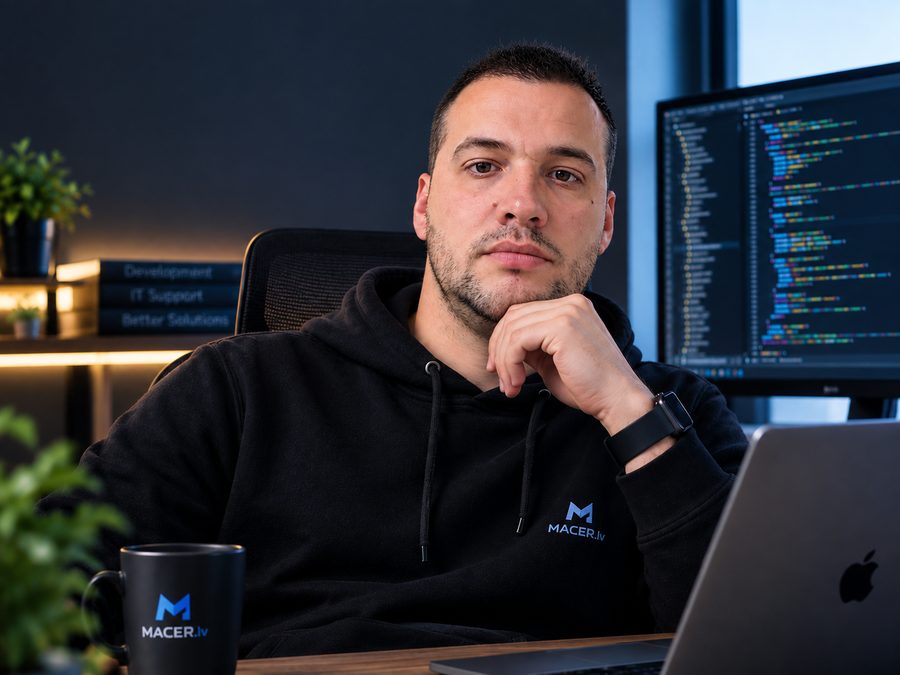
Working with a single specialist means faster decisions and clearer answers. When you ask a question, you get a reply from the person who wrote the code — not a status update passed through three people. That shortens the path from an idea to a working solution considerably.
The work covers the full stack: from company websites and web applications to server-side logic, databases, APIs and system integrations. That breadth matters — instead of treating a task in isolation, I look at where your processes lose time and where a well-built system will give you the most value.
Clients come from different industries — retail, services, production and the B2B sector — but the approach is always the same: understand the process, fix the scope in writing, deliver tested work and stay available after handover. Many of these relationships continue as ongoing maintenance and support, because software is never really "finished" — it evolves together with the business.
You speak with the person who designs, builds and maintains your software. Nothing is lost between an account manager and a development team.
Scope is written down, architecture is deliberate, code is tested and reviewed. The result is a system that can be handed over, extended and maintained.
Technology is only useful when it removes real work. Every decision starts from what the business needs to achieve, not from a favourite tool.
Technical questions get plain answers. You always know what is being done, what comes next and what it costs — in writing, before the work starts.
Systems are laid out so they can be extended without starting over — whether that means more data, more users or entirely new requirements.
Most work continues after launch: maintenance, improvements and support as the business changes.